Happy Home
A shared-living management app that helps bachelor roommates manage expenses, settlements, and household harmony — without awkward conversations.
Role
UX Lead · Product Designer
Platform
Android Mobile App
Stack
React Native · NestJS · PostgreSQL
Output
Functional APK Prototype
Shared homes run on trust. Trust breaks when clarity is missing.
Bachelors in shared homes manage everything through WhatsApp messages, screenshots, and verbal agreements. One person tracks rent. Someone else buys groceries. Someone forgets to pay back. A roommate goes home for a month. Another moves out.
The problem isn't calculation. It's emotional. People avoid asking for money because they don't want conflict. Chore reminders feel personal. Responsibility quietly falls on one person — until it doesn't.

Money conversations become awkward
Direct reminders can feel uncomfortable or trigger ego clashes.
One person carries everything
The responsible roommate handles rent, bills, groceries, and landlord calls — silently.
Absence breaks the system
When someone is away, their chores and responsibilities fall through with no handover.
Move-outs get messy
Deposits, shared assets, pending dues — all unclear when someone leaves.
How Might We
How might we help bachelors manage shared homes peacefully — making expenses, responsibilities, settlements, and member changes transparent, fair, and low-friction?
Designing for real roommate dynamics.
Shared living isn't a single-user experience. Every action affects the entire home.
Persona
Kishore, 24
New to city
The Real Problem
Doesn't know roommates. Needs transparency on deposits, rules, and costs before trusting the group.
UX Opportunity
Onboarding, invite flow, home context, member visibility so new roommates feel safe and informed.
The design decisions that matter.
Each decision follows a clear path: problem → constraint → choice → outcome.
Problem
Transactions feel like the product, but homes are the real unit.
Constraint
Multi-roommate dynamics change constantly.
Decision
Home-first architecture: Home → Members → Expenses → Settlements.
Outcome
A scalable entity model that survives member churn.
Problem
Tracking data alone still leaves awkward conversations.
Constraint
Roommates avoid conflict more than they avoid math.
Decision
Optimize every feature for reduced friction, not just accuracy.
Outcome
Clarity without confrontation becomes the product promise.
Problem
'You owe ₹500' triggers ego and tension.
Constraint
Money language is emotionally loaded.
Decision
Friendly microcopy: 'Can settle when convenient.'
Outcome
Language protects relationships while still driving action.
Problem
Equal split fails for real household expenses.
Constraint
Deposits, personal buys, and selective shares are common.
Decision
Flexible split types: equal, custom %, selected members, deposit-based.
Outcome
The app matches how people actually share costs.
Problem
Absence or move-outs break informal systems.
Constraint
Homes must continue when people leave temporarily.
Decision
Out-of-Home mode with task transfer and resume.
Outcome
Continuity during change without social drama.
Problem
Guilt-based reminders create resentment.
Constraint
Gamification can feel competitive or shaming.
Decision
Harmony Score rewards shared responsibility, not ranking.
Outcome
Healthy habits feel rewarding, not pressured.
From lived friction to functional APK.
A deliberate storytelling arc — each stage informs the next.
01
Problem
WhatsApp-era shared living creates emotional debt.
02
Research
Roommate personas and real conflict patterns.
03
Thinking
Home as the core entity, not the individual.
04
UX Decisions
Friendly money language and flexible splits.
05
Flows
Expense, settlement, and away-mode journeys.
06
Screens
Calm UI validated in a functional APK.
07
Outcome
A calmer system for shared responsibility.
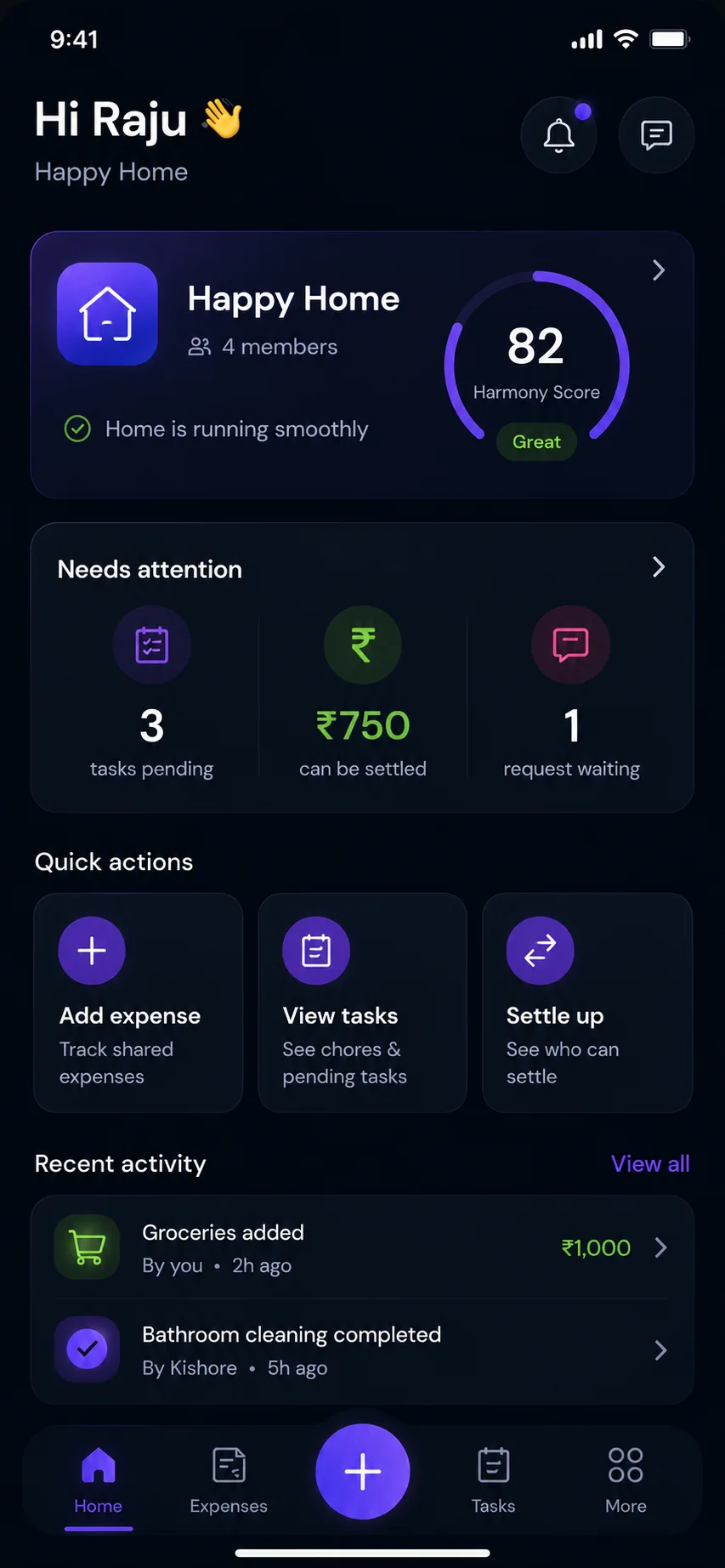
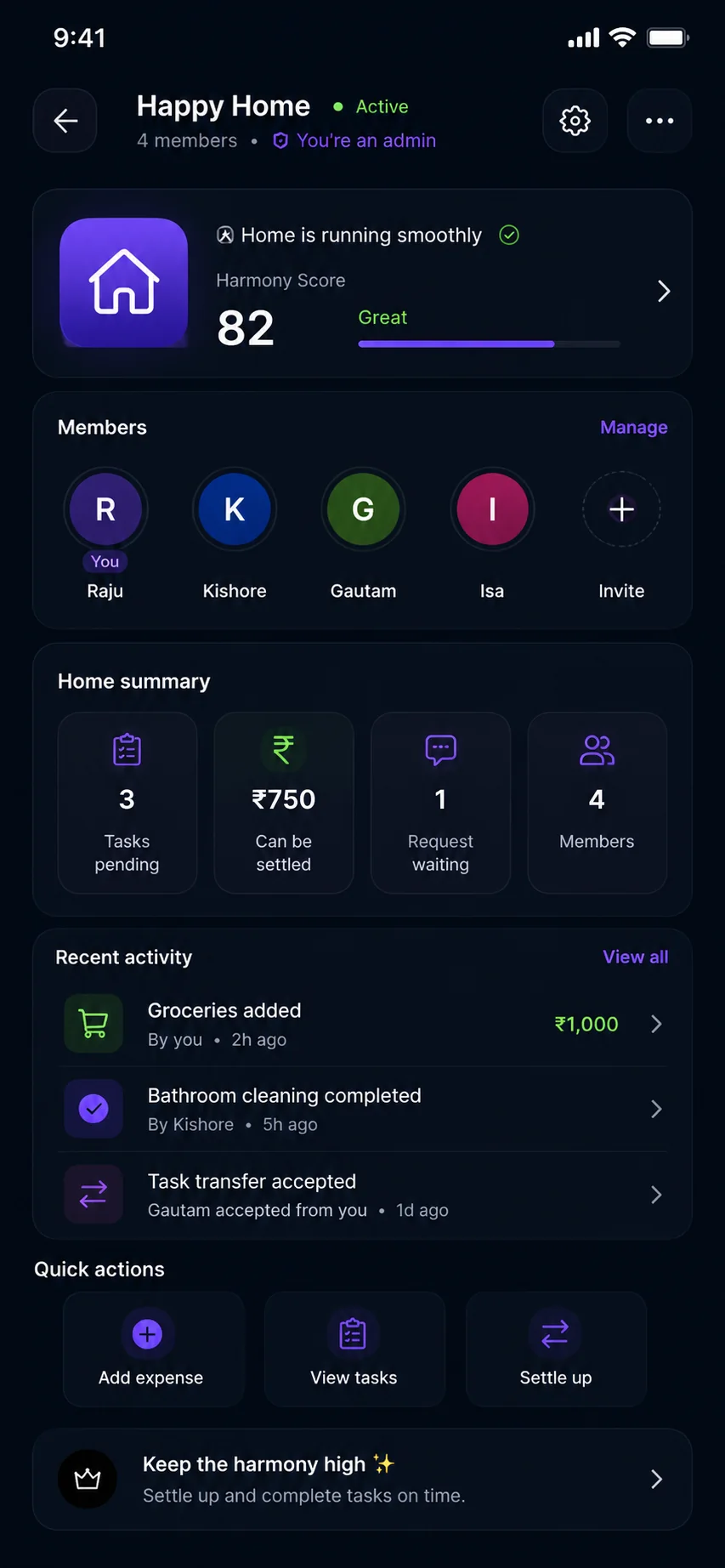
The product in hand.
Floating high-fidelity screens — clarity, calmness, and trust.
Three flows that solve the hardest problems.
Flow 1
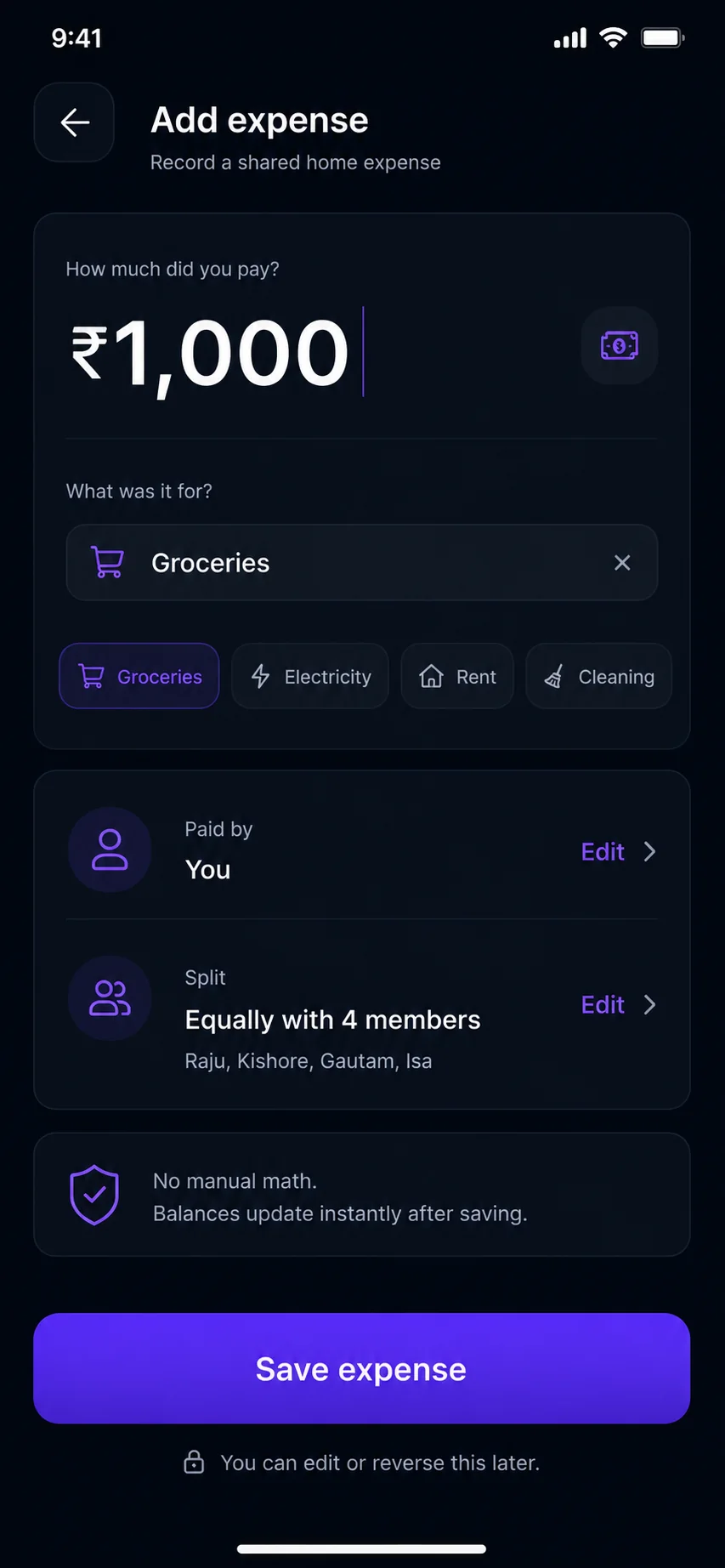
Add & Split an Expense
One roommate pays ₹1,000 for groceries. Adds the expense, selects who to split with, picks a split type. Balances update instantly — no manual math, no WhatsApp messages.
Add expense
Select payer
Choose split type
Pick members
Save → Balance updates
Flow 2
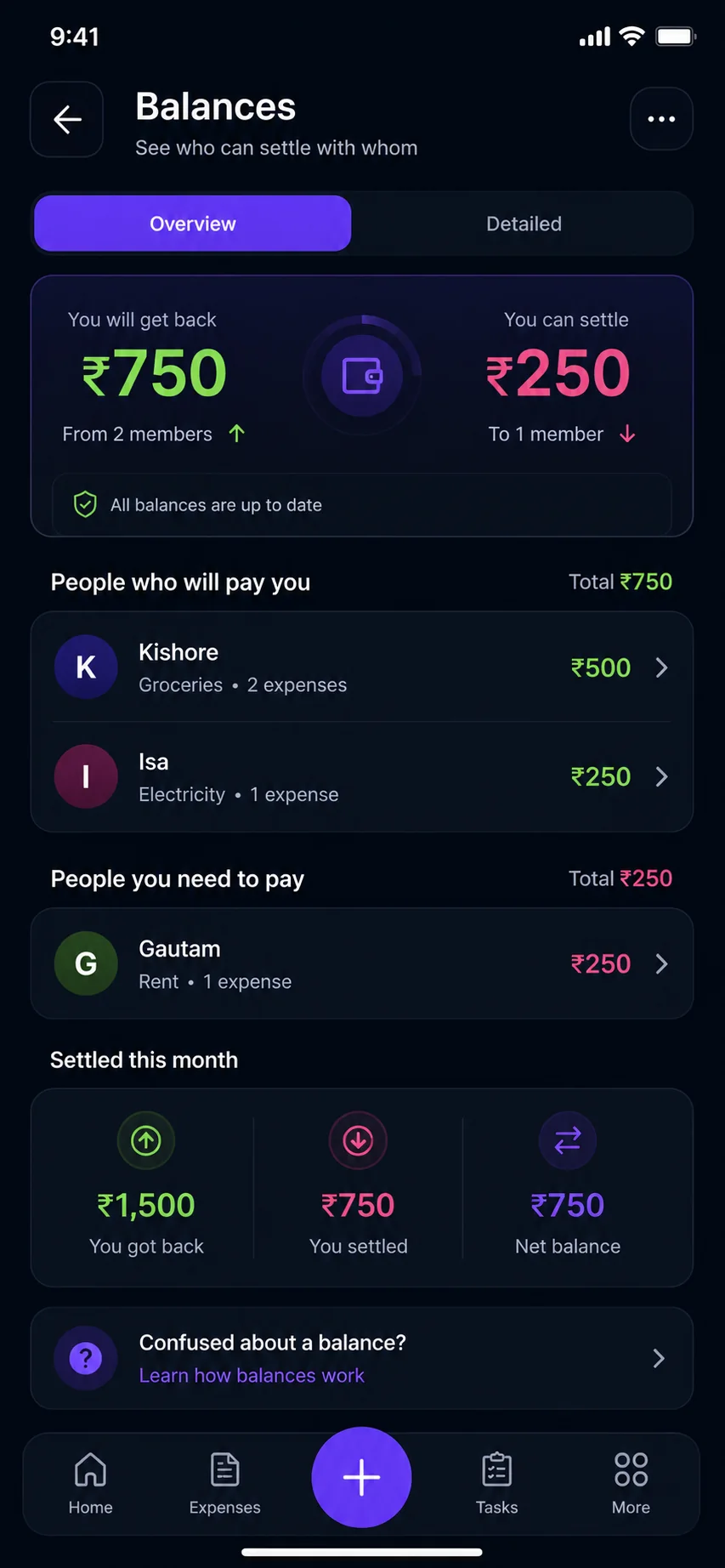
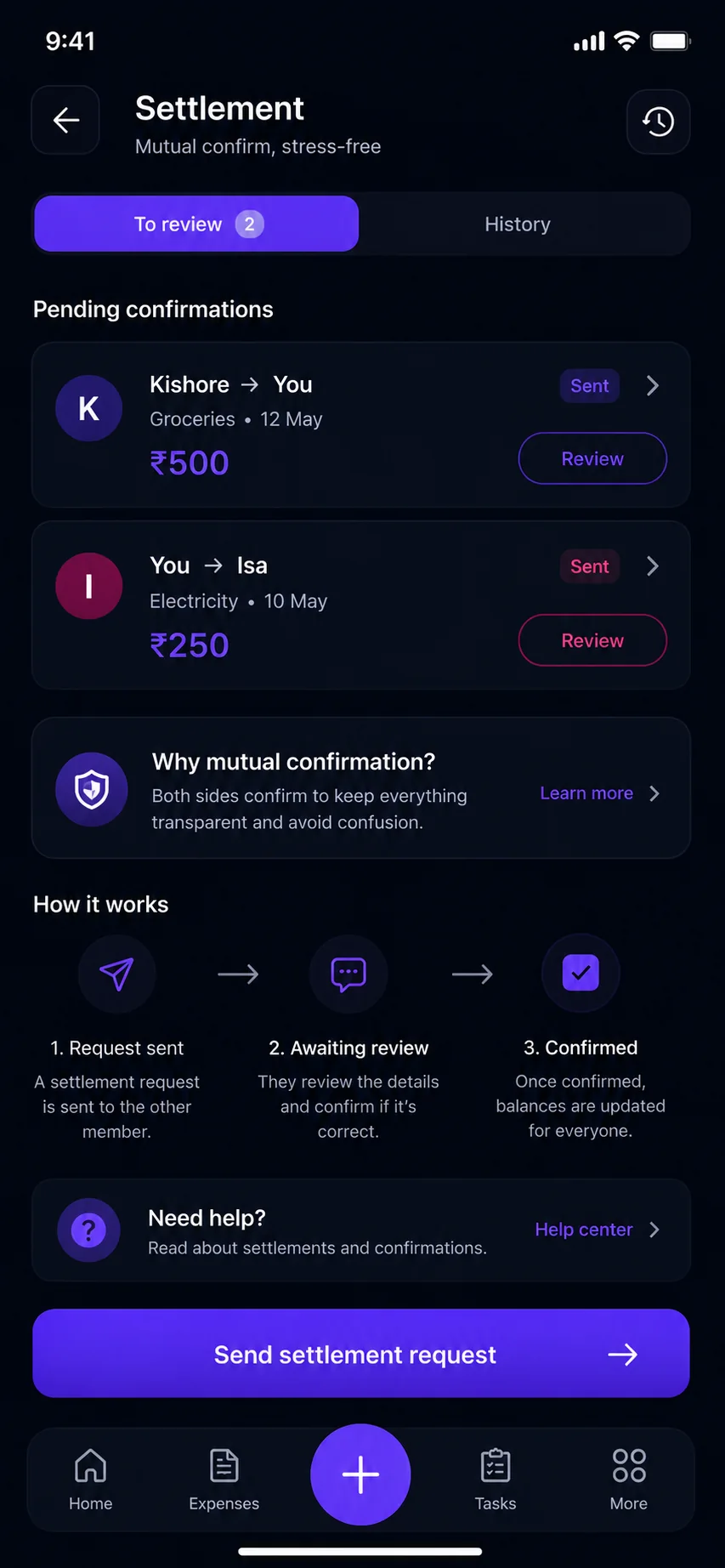
Friendly Settlement
Kishore sees he can settle ₹250 with Raju. Creates a settlement. Raju confirms. Balance clears. No awkward direct message, no ego involved — just a calm mutual confirmation.
View balance
Create settlement
Other member confirms
Balance clears
Flow 3
Out-of-Home Mode
Gautam goes home for a month. Enables Away mode. Chores transfer to available members. No new tasks assigned. When he returns, he rejoins the normal rotation.
Enable away mode
Transfer chores
Pause assignments
Return → Resume rotation
Clarity, calmness, and trust in every screen.
High-fidelity UI screens designed with clarity and trust in mind. The UX intent behind each flow is carefully mapped out.
My Homes
Harmony Score + home cards
Home Detail
Members, balances, quick actions
Add Expense
Flexible split types
Balances
Who can settle with whom
Settlement
Mutual confirm flow
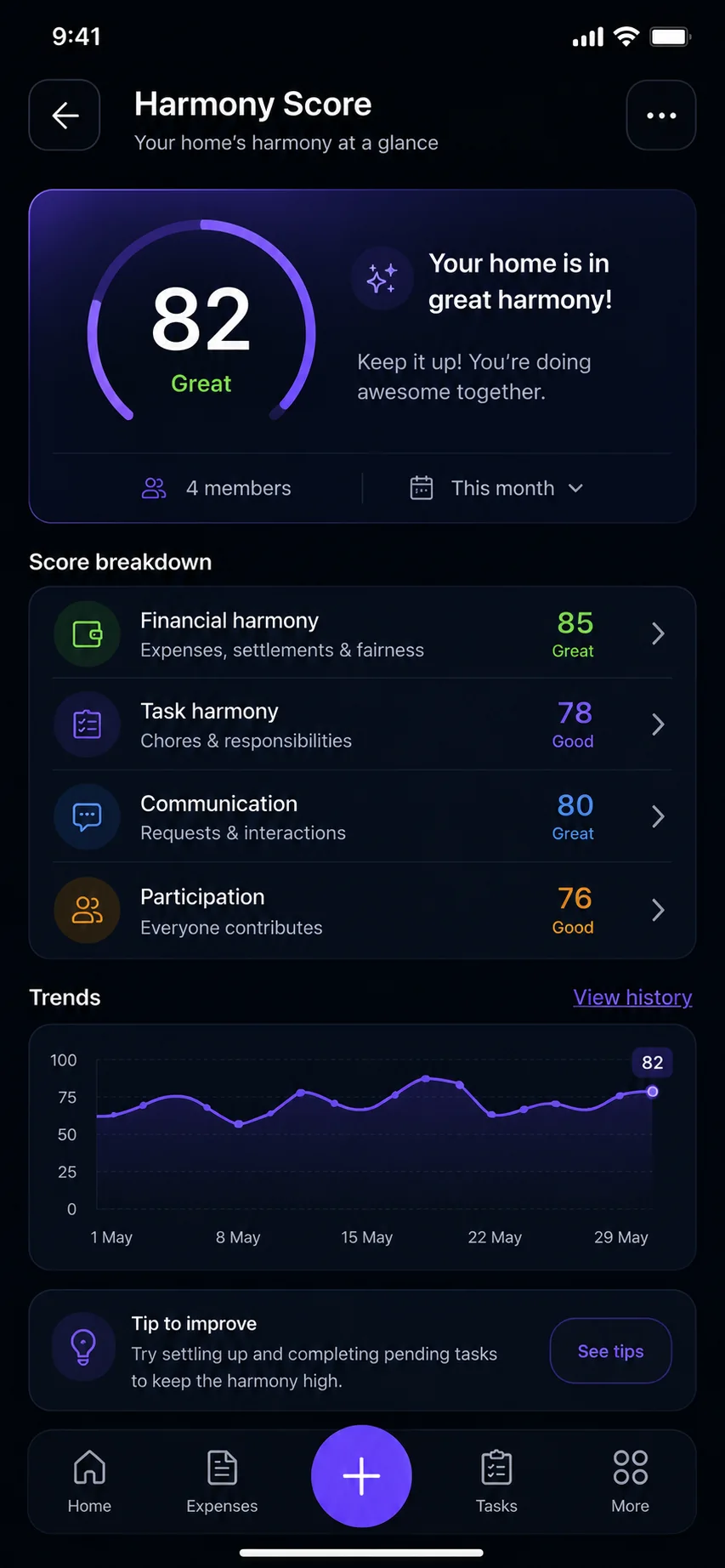
Harmony Score
Gamified household health
The language that removes the awkward.
In a shared-home app, every word is a UX decision. The wrong word creates tension. The right word maintains trust.
Kishore owes ₹300
Kishore can settle ₹300 when convenient
Payment overdue
Small reminder: this settlement is still open
You have debt pending
Your home expenses are almost balanced
Task overdue
Small reminder: this task is still open
Harmony Score — not a leaderboard.
A score between 0–100 based on settled expenses, completed chores, and active members. The goal is to make shared responsibility feel rewarding — not competitive or guilt-inducing.
- Bills settled on time
- Low pending balances
- Chores completed
- No overdue tasks
Harmony Score
Everything looks peaceful today.
4
Badge Types
Peace, chores, groceries, leadership
0
Guilt UX
No public shaming, no debt language
E2E
Product Story
Problem → APK
6+
Core Flows
Multi-user validated
1
Core Entity
Home-first model
APK
Prototype
Functional build
What this project proves.
Happy Home is a full product story — from real-world problem discovery to architecture, UX flows, functional APK, and future vision. It shows how UX leadership turns everyday friction into a calmer, fairer system.
- Defined a real product problem from lived experience
- Designed home-first UX architecture from scratch
- Built flexible expense and settlement flows
- Introduced friendly money microcopy as a core UX layer
- Validated multi-user flows via functional APK
What I learned
Emotional context shapes product decisions
Expense splitting isn't a math problem. It's a relationship problem. UX must protect both.
Multi-user flows expose real complexity
Building the APK revealed edge cases no static mockup would ever catch.
The right core entity unlocks everything
Making "Home" the centre — not the user — created a scalable foundation for every future module.
Shared Living App
Built from real life, not assumptions.
Product strategy, emotional UX, multi-user flows, friendly microcopy, and a functional APK — all from one real problem in shared living.
Continue Exploring
Related Product Explorations
Shared Spending · Mobile Product
Splitflow
A mobile-first product exploration designed around the moments people share — reducing friction in everyday shared spending.
Work Intelligence · Governed AI
Weekwise
An independent product exploration connecting operational evidence, role-based workflows and human-centred AI within one platform.